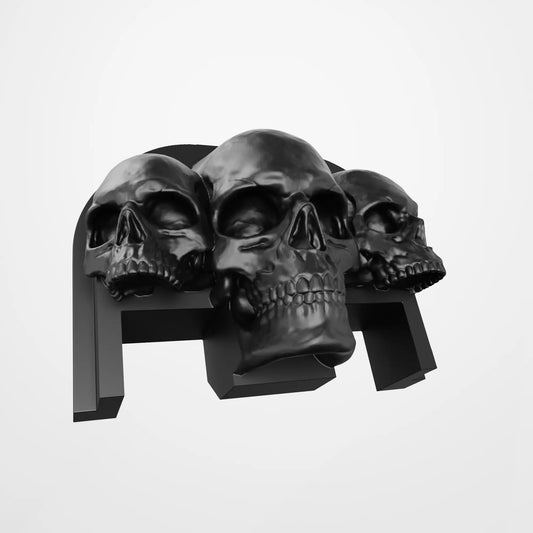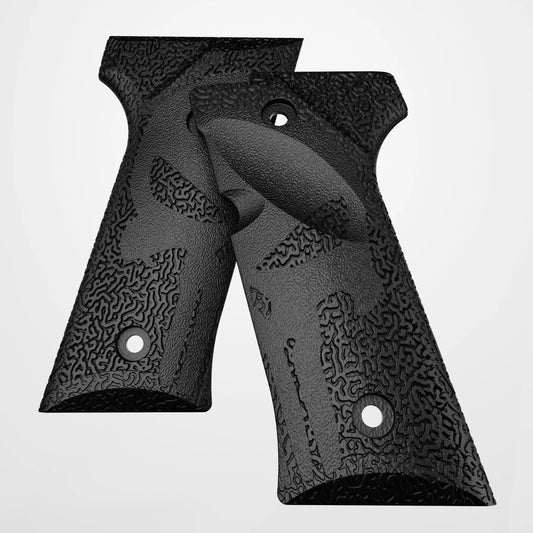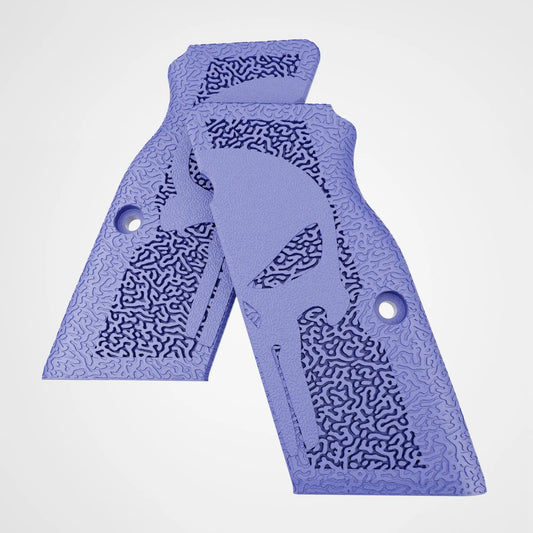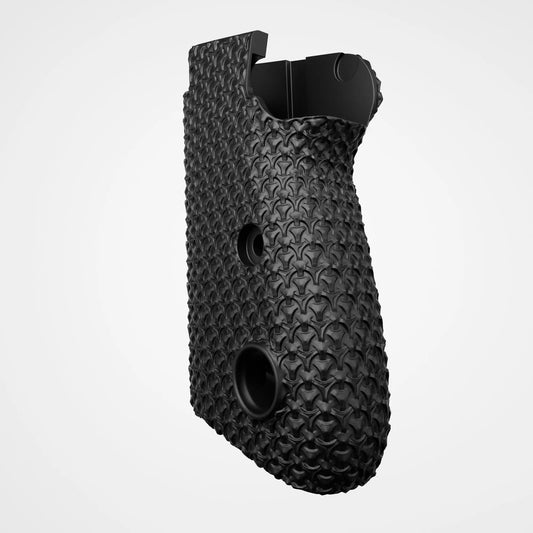
Aftermarket Glock Backplates: Safety, Structure and Technical Considerations
One of the most common questions we receive from customers considering an aftermarket Glock backplate concerns the presence of the metal reinforcement found in the original plate, and whether the absence of that insert could create risks or issues during firearm use.
This article aims to explain clearly and technically:
- how the Glock backplate works
- what forces act on this component
- the role of the metal reinforcement in the original Glock plate
- what changes when using an aftermarket plate made of resin or polymer
- the real practical implications for the user
What the Glock Backplate Is and What It Does
The backplate is the plate that closes the rear portion of the Glock slide.
Its main function is to retain and keep several internal slide components in position, particularly:
- Striker assembly (firing pin and firing pin spring)
- Extractor depressor plunger assembly
- Spacer sleeve
These components are pushed toward the rear of the slide by their respective springs, and the backplate acts as a retention element that prevents them from coming out.
The backplate is not a component that contains firing pressure and it is not part of the firearm’s locking system. Its function is purely mechanical: retaining the internal components of the slide.
Forces Acting on the Backplate
During normal Glock operation, the backplate is primarily subjected to the static pressure of two internal springs:
- Firing pin spring
- Extractor depressor plunger spring
When the firearm is assembled and ready for use, these springs exert constant pressure on the components that are retained by the backplate.
This is the normal operating condition of the firearm and represents the main static load applied to the backplate.
It is important to understand that:
- the backplate does not receive the pressure generated by firing
- it is not part of the locking system
- it does not contribute to the structural strength of the chamber
Its role remains exclusively to retain the internal slide components.
The Metal Reinforcement in the Original Glock Plate
Original Glock backplates include a small internal metal insert that can be seen from the side of the component.
This reinforcement likely serves several practical purposes:
- increasing the structural rigidity of the polymer
- reducing the risk of deformation over time
- improving resistance to wear from repeated installation and removal
- increasing resistance to impacts or shocks
Glock has never published official technical documentation describing the exact function of this insert, but the most widely accepted interpretation is that it mainly serves as structural reinforcement for the polymer component.
Aftermarket Backplates Without Metal Reinforcement
Many aftermarket backplates, particularly those made from technical polymers or resins, do not include an internal metal insert.
This often raises a legitimate question:
Does the absence of the metal reinforcement make the component less safe?
From a functional perspective, when the firearm is used correctly and properly maintained, the absence of the metal insert does not normally represent a safety risk for the user.
The backplate still performs the same mechanical retention function for the internal slide components.
What Happens if a Backplate Breaks
In the purely hypothetical event of a backplate failure, the internal components retained by it would lose their retention.
In particular, the following parts could come out from the rear of the slide:
- the firing pin
- the firing pin spring
- the spacer sleeve
- the extractor depressor plunger assembly
In such a situation, the practical result would simply be that the firearm becomes immediately inoperable, since the components necessary for the firing cycle would no longer be retained in position.
Considerations for Sport or Professional Use
The decision to use aftermarket components on a firearm is always a personal one.
In certain specific contexts, such as:
- competitive shooting
- professional or duty use
some users prefer to keep every component completely original in order to minimize even the smallest possible risk of malfunction.
Even an extremely small theoretical increase in the probability of failure may be considered unacceptable when maximum reliability is the top priority.
For this reason, it is always advisable to carefully evaluate the intended use of the firearm before installing any aftermarket component.
Abnormal Conditions Related to Ammunition
There are also abnormal situations related to ammunition that can cause damage to a firearm regardless of the type of backplate installed.
Examples include:
- squib loads (a projectile stuck in the barrel)
- reloading errors
- defective ammunition
In such scenarios, the danger is inherent to the firearm’s operation and can lead to the failure of mechanical components.
The energy generated in these situations is such that secondary components like the backplate, regardless of their construction material, are not designed to contain those forces.
Good Safety Practices
- verify correct component compatibility
- ensure the installation is performed correctly
- perform a functional check of the firearm
- periodically inspect components for signs of wear or damage
- always use personal protective equipment when shooting
If you do not have experience with firearm maintenance, it is advisable to have the component installed by a qualified gunsmith.
Disclaimer
The information contained in this article is provided for informational and educational purposes only.
The installation and use of aftermarket components on a firearm are decisions that belong exclusively to the firearm’s owner and user, who is responsible for verifying compatibility, proper installation, and maintenance of the installed components.
The manufacturer and seller cannot control:
- how the product is installed
- the condition of the firearm on which it is installed
- the type of ammunition used
- the conditions in which the firearm is used
Therefore, we assume no responsibility for damage, malfunctions, injuries, or other consequences resulting from:
- improper or incorrect installation of products
- use of products on incompatible or modified firearms
- inadequate firearm maintenance
- improper use of the firearm or its components
- component failure due to wear, abuse, or abnormal conditions of use
Aftermarket components should only be installed by competent individuals or by a qualified gunsmith.
Always use firearms in compliance with applicable laws and follow all fundamental firearm safety rules.